
Club The Strongest – History, Honours and Club Profile in Bolivia
El Tigre Aurinegro – The Oldest Club in Bolivia
16 Bolivian Primera División titles. A battle named after a football club. Over a century unbeaten by relegation.
Club The Strongest is not simply the oldest active football club in Bolivia – it is a living institution that has been woven into the country’s social, military, and sporting fabric for more than a century. Founded in La Paz in 1908, the club has spent every season of its existence in the top flight of Bolivian football, a record of unbroken top-division presence that no other club on the continent can rival over the same period. From its founding on a high-altitude plateau that would challenge any team on the planet, through the tragedy of the Viloco air crash and into the modern era of continental competition, The Strongest has embodied resilience, ambition, and identity in a way that makes it uniquely significant in South American football.
Club History
Foundation and Early Dominance: 1908-1930
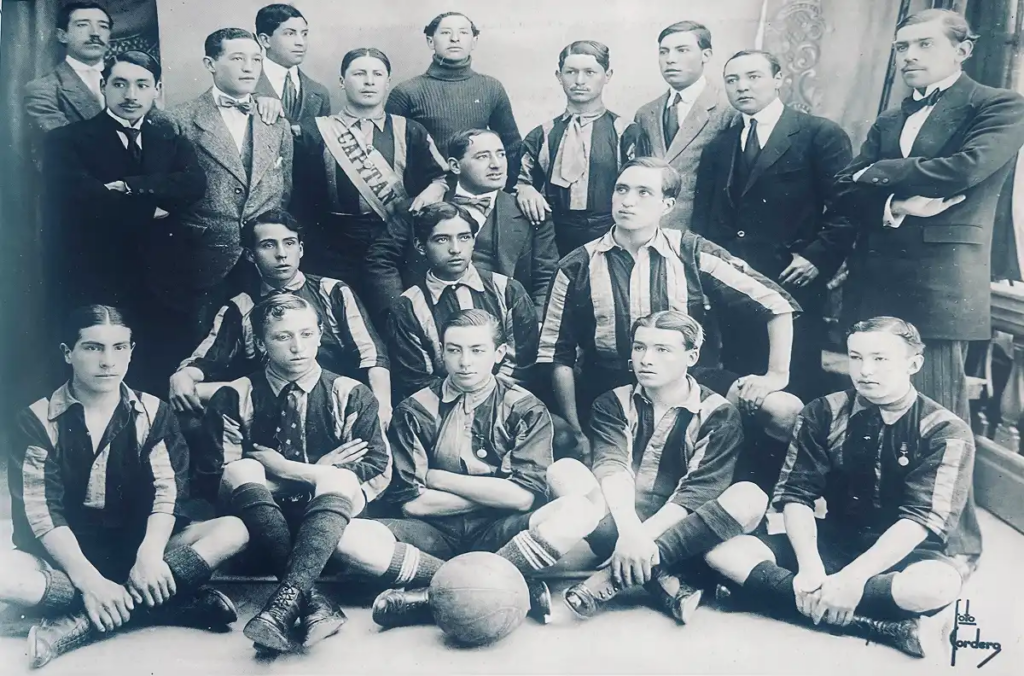
Club The Strongest was founded on 8 April 1908 by a group of twelve students in La Paz, Bolivia. The club was originally known as “The Strong Football Club” before evolving into “The Strongest Football Club” – or El Club Más Fuerte in Spanish. Its first president and founder was José León López Villamil, whose name would become emblematic of the club’s commitment to discipline and community. The choice to name the club in English, at a time when the language of the British community in South America carried considerable prestige in sporting circles, reflected the founders’ ambitions to create something of lasting consequence. From the very beginning, The Strongest was not conceived as a local pastime but as an institution – a point of civic pride for a city already establishing itself as the political capital of a young republic.
The club’s earliest competitive record reflects exactly that level of ambition. By 1911 – just three years after foundation, and before most of the clubs that currently exist in Bolivian football had even been created – The Strongest won the Copa Prefectural, Bolivia’s first organised football tournament, defeating Nimbles Sport in the final. In 1914, members of the club co-founded the La Paz Football Association (LPFA), the first regional governing body for football in Bolivia, and the club claimed the inaugural Campeonato Paceño title that same year. Regional championships followed across the 1910s and 1920s in 1916, 1917, 1922 through 1925, 1930, 1935, 1938, 1943, 1945, 1946, and 1952, establishing The Strongest as the dominant force in Paceño football across four decades. In 1930, the club achieved a record that has never been equalled in Bolivian football: winning the league championship without conceding a single goal throughout the entire campaign – a perfect defensive record that stands as one of the most remarkable achievements in the history of the sport in South America. That same year, The Strongest inaugurated the Estadio Hernando Siles with a 4-1 victory over their rival Universitario.
The Chaco War and the Batalla de Cañada Strongest
The early 1930s brought circumstances that transformed The Strongest from a successful sports club into a phenomenon with a truly unique place in history. When Bolivia became embroiled in the Chaco War (1932-1935) – a devastating conflict with Paraguay over the Gran Chaco region – the players, staff, and members of the club, who numbered approximately 600 at the time, answered the call to arms and enlisted in the Bolivian Army. A division of soldiers composed largely of these Stronguistas played a decisive role in what proved to be the Bolivian Army’s most significant victory of the entire war. In recognition of their contribution, the battle in which they fought was named the “Batalla de Cañada Strongest” – a designation that appears in Bolivian military history books to this day. The Strongest is therefore the only football club in the world to have an actual military battle named after it: a distinction that elevates the institution above the ordinary parameters of sport and into the realm of national history.
The Viloco Tragedy and Rebirth: 1969-1977
On 26 September 1969, one of the most catastrophic moments in the history of Bolivian sport occurred. The Strongest’s squad had travelled to Santa Cruz to participate in an exhibition match organised by the local football association. On the day of their return to La Paz, the Lloyd Aéreo Boliviano DC-6 aircraft carrying sixteen of the team’s first-team players, one player on loan from Olympic, the head coach Eustaquio Ortuño, and manager José Ayllón Guerra, disappeared en route. A day later, it was confirmed that the aircraft had crashed near Viloco, a rural area between the Tres Cruces Peaks. All 69 passengers and five crew members died. The Viloco crash remains the most devastating football disaster in Bolivian history, wiping out virtually the entire first-team squad of The Strongest in a single moment and leaving the club in a state of profound institutional and emotional shock.
Under the leadership of president Rafael Mendoza Castellón – widely regarded as the greatest administrator in the club’s history – The Strongest refused to dissolve. Instead, Mendoza promoted talented youth players from the lower divisions to form what became known as “The Strongest Símbolo” squad, honouring the memory of the victims while blending survivors with emerging talent and players loaned by international clubs including Boca Juniors. This rebuilt squad achieved a landmark result: the 1974 Bolivian Primera División title, The Strongest’s first national championship, which simultaneously qualified them for the 1975 Copa Libertadores. Mendoza’s tenure, which ran from 1967 to 1980, also produced the Achumani Sports Complex – including the construction of the Estadio Rafael Mendoza Castellón – and coincided with the club becoming one of the founding members of the Bolivian Professional Football League in 1977, a tournament whose inaugural edition The Strongest also won.
Continental Campaigns and the Modern Era: 1980-2023
The professional era saw The Strongest cement its status as one of Bolivia’s two great clubs. In 1989 they won the league title again, qualifying for the 1990 Copa Libertadores. In 2003, under Argentine manager Néstor Clausen, the club became the first in Bolivia to win both the Apertura and Clausura in a single calendar year – a feat that made them the first “Bicampeón” in the history of the new two-tournament format. In 2012 and 2013, under Bolivian manager Eduardo Villegas, the club claimed the Apertura 2012, Clausura 2012, and Apertura 2013 titles in succession, becoming the first “Tricampeón” in Bolivian football history – three consecutive tournament titles in the modern era. The club’s most recent national title was the Clausura 2023, extending their total to 16 Primera División championships and reaffirming their position as the second most decorated club in Bolivian football history.
In continental competition, The Strongest reached their highest achievement in the 2005 Copa Sudamericana, when they defeated fierce rivals Bolívar 4-2 on aggregate before beating Ecuador’s LDU Quito – including a 3-0 victory in Quito – before falling to Mexico’s Pumas UNAM in the round of 16, the team that would go on to finish as runners-up. In the 2017 Copa Libertadores, the club had its best-ever run in that competition, beating Montevideo Wanderers 6-0 on aggregate and Unión Española 6-1 on aggregate to reach the group stage, where they narrowly missed progression to the knockout rounds, eventually losing 2-1 on aggregate to Lanús in the round of 16.
What Makes Club The Strongest Stand Out
Club The Strongest occupies a position in Bolivian football that has no direct equivalent anywhere else in South America. The combination of being the oldest continuously active club on the continent without a single relegation, having a military battle named in its honour, and competing at one of the highest altitudes of any professional football venue in the world creates an identity that is entirely its own. The club has played every season of its existence – from 1908 to the present – in the top division of Bolivian football, a record spanning more than a century that no club anywhere can match over the same timeframe. This continuity has given The Strongest an institutional depth that underpins everything from its youth academy to its matchday culture.
The club’s rivalry with Bolívar – the “Clásico Paceño” – is one of the most fiercely contested derbies in South American football. Both clubs are based in La Paz, both draw enormous support from the city’s population, and their encounters are invariably the most anticipated fixtures in the Bolivian football calendar. The Clásico Paceño draws not merely rivalry between two sets of supporters but a broader cultural contest that encompasses questions of identity, class, and civic pride in Bolivia’s political capital. When The Strongest eliminated Bolívar 4-2 on aggregate in the 2005 Copa Sudamericana – in a continental competition, on the wider South American stage – the significance of that victory reverberated well beyond Bolivian borders, as it was a moment that announced the club’s capacity to compete credibly at the regional level.
The Strongest’s high-altitude home at the Estadio Hernando Siles also gives the club a strategic advantage that visiting teams from lower altitudes consistently find difficult to overcome. La Paz sits at approximately 3,600 metres above sea level, and the physiological effects of reduced oxygen on unacclimatised players are profound. The Strongest and their La Paz rivals have built careers in this environment, while visiting clubs from Buenos Aires, Montevideo, São Paulo, and Lima arrive already disadvantaged by altitude sickness and reduced aerobic capacity. This geographical factor has shaped the club’s continental campaigns and given them results – such as the historic 1-0 defeat of São Paulo at Estadio Hernando Siles in the 2016 Copa Libertadores – that would be difficult to explain without reference to the altitude at which the match was played.
Honours and Achievements
Bolivian Primera División – 16 titles:
- 1952, 1958, 1964, 1974, 1977, 1989, 2000, 2003 (Apertura), 2003 (Clausura), 2009, 2012 (Apertura), 2012 (Clausura), 2013 (Apertura), 2016, 2021, 2023 (Clausura)
Copa Bolivia – 3 titles:
- 1977, 1984, 2000
Campeonato Paceño (La Paz regional championship):
- 15 titles between 1911 and 1958 including 1911, 1914, 1916, 1917, 1922-1925, 1930, 1935, 1938, 1943, 1945, 1946, 1952
Distinctions:
- Oldest active football club in Bolivia (founded 1908)
- Only club in Bolivia never to have been relegated from the top division, having competed continuously for over a century
- Only football club in the world to have a military battle named after it: the Batalla de Cañada Strongest (Chaco War, 1932-1935)
- First Bolivian club to win the national championship without conceding a goal (1930)
- First “Bicampeón” of the Bolivian professional two-tournament format (Apertura and Clausura 2003)
- First “Tricampeón” in Bolivian football history (2012 Apertura, 2012 Clausura, 2013 Apertura)
- Best Copa Libertadores run: Round of 16, 2017
- Best Copa Sudamericana run: Round of 16, 2005
Home Ground
Estadio Hernando Siles – Bolivia’s High-Altitude Cathedral
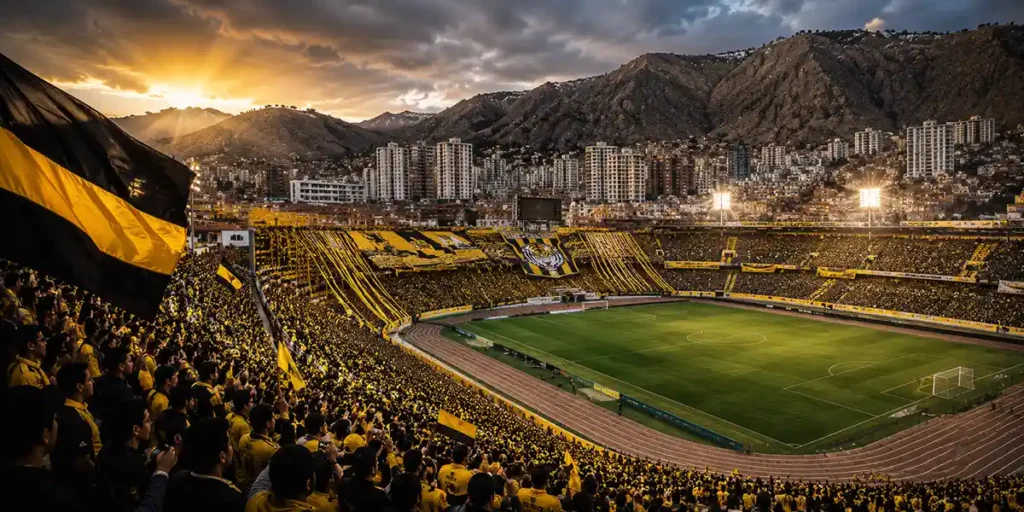
The Estadio Hernando Siles is Bolivia’s national stadium and one of the most remarkable football venues in the world, both for its institutional history and for its extreme geographical setting. Located in the Miraflores neighbourhood of La Paz at an altitude of approximately 3,600 metres above sea level, it is among the highest football stadiums used for top-level professional and international competition anywhere on the planet. The stadium was inaugurated by The Strongest themselves in 1930, when the club defeated their rivals Universitario 4-1 in the opening fixture. Named after Bolivian president Hernando Siles Reyes – who served as head of state from 1926 to 1930 – the ground has been the home of The Strongest for more than nine decades and has hosted Bolivia’s national team in FIFA World Cup qualifying campaigns, Copa América fixtures, and Copa Libertadores matches over that span.
The stadium’s current seated capacity is 41,143 spectators – making it by far the largest venue in which The Strongest regularly competes, dwarfing their own Estadio Rafael Mendoza, which holds 15,000. The Estadio Hernando Siles underwent significant renovation work in preparation for the 2001 Copa América hosted by Colombia (some matches were played in Bolivia), and has since been maintained as a FIFA and CONMEBOL-approved international venue. The altitude of the ground is so significant that FIFA imposed a temporary ban on international competitive football at venues above 2,500 metres above sea level in 2007, a ban that specifically targeted La Paz and El Alto; after Bolivian protests and medical review, the ban was lifted. This controversy underscored just how uniquely challenging the Estadio Hernando Siles is as a competitive environment – for visiting clubs from sea-level football cultures, it remains one of the most demanding away days in South American football.
Club Culture and Identity
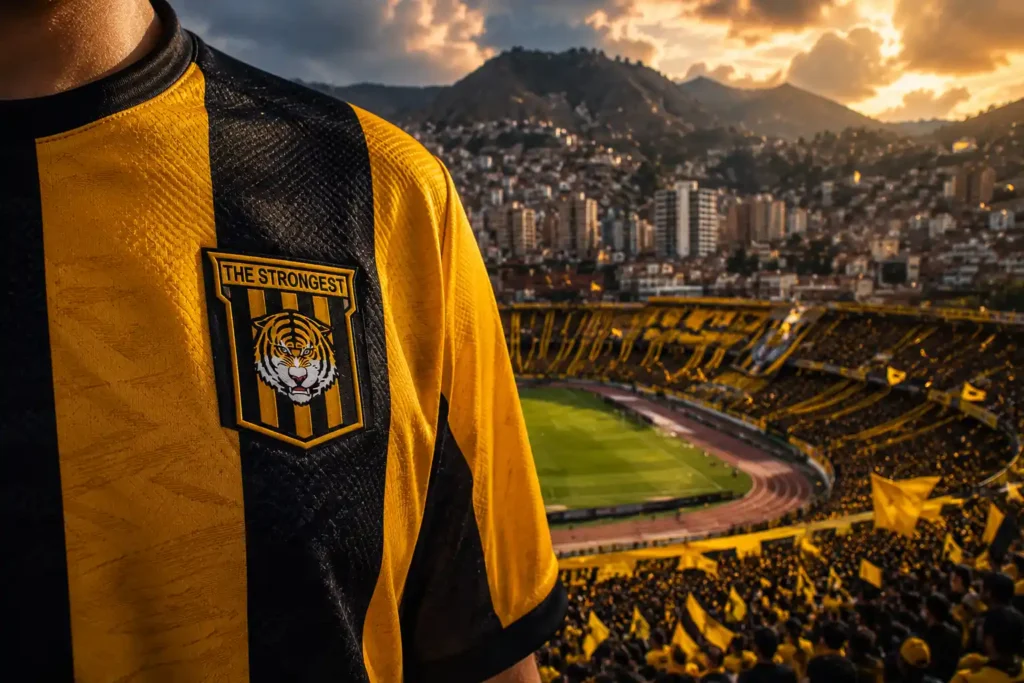
The Tigre Aurinegro – Yellow, Black, and a Century of Identity
The Strongest’s colours of yellow and black have been inseparable from the club’s identity since the very moment of its foundation in 1908. The origin of this distinctive combination is a story in itself. When the twelve founding students sought a playing kit for their new club, a friend sent them a shirt from Germany that featured dark green with horizontal yellow stripes. One of the founders remarked that the colours were reminiscent of a local Bolivian bird, the Chayñita – a small bird with striking black and yellow plumage native to the Andean region. Upon this observation, the founders settled on yellow and black as their permanent colours: a direct link between the club’s visual identity and the natural world of the Bolivian highlands. This origin story, part of the club’s foundational mythology, is one reason why the colours carry such emotional resonance with supporters – they connect the club not just to football but to the landscape and wildlife of Bolivia itself.
The club’s primary nicknames – Tigre Aurinegro (the Yellow-and-Black Tiger), Gualdinegro (from “gualdo” meaning golden yellow, and negro meaning black), and El Decano (The Dean, a reference to the club’s seniority as the oldest institution in Bolivian football) – each reflect a different dimension of The Strongest’s identity. El Tigre evokes aggression, strength, and the natural power of a predator; El Decano places the club in its historical context as the patriarch of Bolivian football. The club’s supporters – known collectively as the Atigrados – fill the yellow-and-black sections of Estadio Hernando Siles with coordinated displays, chants, and the distinctive atmosphere of a fanbase that takes its identity from more than a century of unbroken top-division football. The club’s crest features a tiger, directly referencing the Tigre nickname, framed within a shield that represents the club’s founding colours and its institutional heritage. The annual Clásico Paceño against Bolívar is when this culture reaches its most intense expression: a derby that divides the city of La Paz along lines of allegiance so entrenched that they have been described by Bolivian journalists as one of the most tribal and passionate local rivalries on the continent.
Frequently Asked Questions
In what year was Club The Strongest founded?
Club The Strongest was founded on 8 April 1908 by a group of twelve students in La Paz, Bolivia. The club was originally known as “The Strong Football Club” before adopting its current name. Its first president and founder was José León López Villamil.
How many titles has Club The Strongest won?
Club The Strongest has won 16 Bolivian Primera División titles – the second highest total in Bolivian football history – along with 3 Copa Bolivia titles. The club also won 15 Campeonato Paceño (La Paz regional championship) titles between 1911 and 1952, and is the only club in Bolivia never to have been relegated from the top flight.
What is Club The Strongest’s home stadium and what is its capacity?
Club The Strongest play their home matches primarily at the Estadio Hernando Siles in La Paz, Bolivia, which has a capacity of 41,143 spectators. The stadium sits at approximately 3,600 metres above sea level, making it one of the highest football venues used for professional competition in the world. The club also owns the Estadio Rafael Mendoza with a capacity of 15,000, used for select home fixtures.
What are Club The Strongest’s club colours?
Club The Strongest’s official colours are yellow and black – a combination adopted at the club’s foundation in 1908, inspired by the Chayñita bird native to the Bolivian Andes. These colours give rise to the nicknames Tigre Aurinegro and Gualdinegro, and are displayed on the traditional yellow-and-black horizontal striped playing kit.
Who is the most famous player in Club The Strongest’s history?
Several internationally recognised players have worn the yellow and black. Among the most celebrated is Gustavo Quinteros, who represented The Strongest and was part of the Bolivian squad at the 1994 FIFA World Cup – Bolivia’s most recent World Cup appearance. Marcelo Torrico, Óscar Sánchez, and José Melgar were also members of that historic 1994 World Cup squad and had significant careers with The Strongest.