
 The Strongest
 Aurora
 Blooming
The Strongest
Blooming
The Strongest
 Gualberto Villarroel SJ
The Strongest
The Strongest
Gualberto Villarroel SJ
The Strongest
The Strongest
 Oriente Petrolero
Club The Strongest Bolivia – El Decano of South American Football
Your authoritative source for Club The Strongest news, history, statistics, and match fixtures.
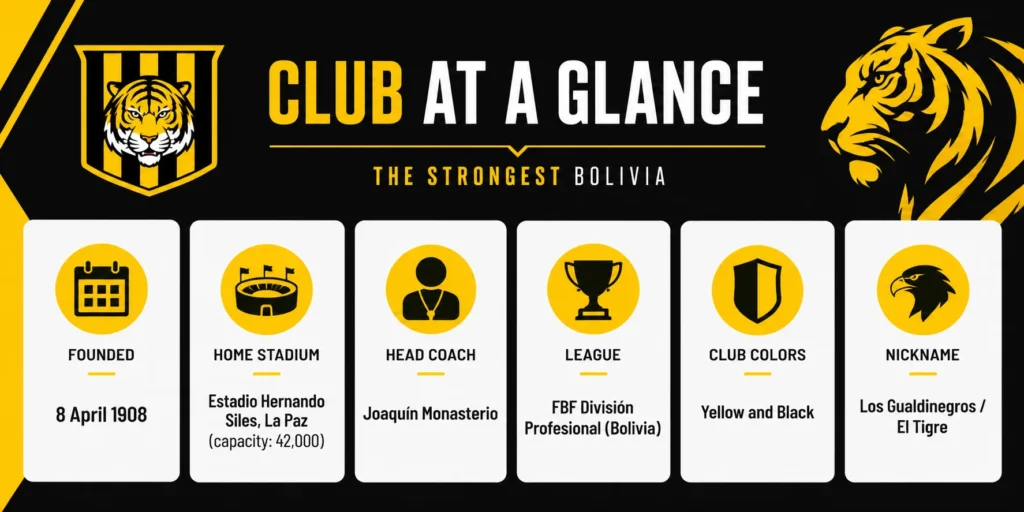
Club The Strongest is a professional football club based in La Paz, Bolivia, and the oldest continuously active football club in the country. Founded on 8 April 1908, The Strongest competes in the FBF División Profesional Bolivia’s top – flight professional league – and is recognized throughout South America as one of the continent’s most historic football institutions. Playing their home games at the iconic Estadio Hernando Siles, the national stadium of Bolivia, The Strongest have accumulated 16 national league titles across more than a century of competition and stand as the permanent embodiment of La Paz football culture.
Club at a Glance
Next Match
Club The Strongest vs Club Bolívar | FBF División Profesional 2026 | Estadio Hernando Siles, La Paz
The Clásico Paceño – the fixture between Club The Strongest and Club Bolívar – is the most important derby match in Bolivian football and one of the most fiercely contested rivalries on the South American continent. Played out at altitude in one of the most atmospheric stadiums in Latin America, this encounter between the two great clubs of La Paz commands national attention and unites and divides the city like nothing else in Bolivian sport.
About Club The Strongest
Club The Strongest was founded on 8 April 1908 by a group of twelve students who gathered at the home of Alberto Requena in La Paz, Bolivia. The initiative was led by José León López Villamil, who became the club’s first president, with Alberto Tavel serving as vice president and Francisco Guachalla as secretary. Initially called “Strong Football Club,” the institution was established at a moment when football was rapidly spreading across South America through European commercial and cultural influence, and La Paz’s young students were among the first to adopt and champion the sport in the high – altitude Bolivian capital. The club’s yellow and black colors – which have remained unchanged since foundation – were adopted following the arrival of a German shirt featuring horizontal yellow stripes, which one of the founders compared to the coloring of the Chayñita, a locally recognized Bolivian bird. From that observation, a visual identity was born that has defined the club for over 117 years.
The depth of The Strongest’s connection to Bolivian national life extends far beyond football. In the Chaco War of 1932 to 1935 – the devastating territorial conflict between Bolivia and Paraguay – more than 600 players, staff members, and club associates enlisted in the Bolivian Army. A division composed largely of these “Stronguistas” played a decisive role in the Bolivian Army’s most significant military victory of the war. That battle has since been officially named the Batalla de Cañada Strongest, making Club The Strongest the only football club in the world to have an active military engagement named in its honor. This extraordinary piece of history speaks to the club’s role not just as a sporting institution, but as a pillar of Bolivian cultural and national identity.
The Strongest became a founding member of the country’s first professional football league in 1950 and immediately established themselves as one of the dominant forces in the new professional era. In 1952, the club claimed its first professional championship via the Torneo Interdepartamental. However, the most extraordinary chapter in the club’s early competitive history came across the 1960s, when The Strongest achieved an unprecedented seven consecutive league titles – a run of domestic dominance that remains unmatched in Bolivian football history and that cemented the club’s reputation as the defining institution of the era. In 1964, The Strongest won the Copa Simón Bolívar, which earned them entry to the 1965 Copa Libertadores – the club’s first – ever continental competition. In that tournament, The Strongest made history by achieving Bolivia’s first – ever away victory at club level, defeating Ecuador’s Deportivo Quito. Their group stage performance – finishing second behind Argentina’s Boca Juniors – announced the club’s quality on the South American stage.
In 1977, when Bolivia formalised its football pyramid with the creation of the Liga de Fútbol Profesional Boliviano, The Strongest became the inaugural champions of the new structure, defeating Oriente Petrolero 3 – 1 in the final played in Cochabamba on 29 March 1977. This milestone – becoming the first professional champions of modern Bolivian football – cemented the club’s status as the defining force in the development of the domestic game. The period from 1967 to 1980, under the presidency of the legendary Rafael Mendoza – for whom the club’s own Estadio Rafael Mendoza is named – saw The Strongest navigate severe national economic crises, the devastating Viloco air tragedy of 1969 in which several club members perished, and the reconstruction of a competitive squad that nonetheless achieved repeated national success. Mendoza is widely regarded as the greatest administrator in the club’s history.
The modern era has seen continued moments of championship glory. In 2003, under Argentine manager Néstor Clausen, The Strongest won both the Apertura and Clausura titles in the same calendar year, becoming the first “Bicampeón” in the new league format. Their 2023 División Profesional title – the club’s 16th overall – reaffirmed their place among Bolivia’s elite, as head coach Eduardo Villegas guided the squad to a dominant campaign that included an 8 – 0 defeat of Libertad Gran Mamoré and qualification for the Copa Libertadores group stage. The Strongest have made a total of 15 Copa Libertadores appearances since 1965, and in the 2005 Copa Sudamericana recorded their best – ever continental run, defeating rivals Bolívar 4 – 2 on aggregate in one of the most celebrated Clásico Paceño outcomes in the history of the rivalry.
The club plays the majority of its home fixtures at the Estadio Hernando Siles – Bolivia’s national stadium in the Miraflores district of La Paz – which has a capacity of 42,000 spectators and sits at an altitude of approximately 3,637 metres above sea level. This altitude has long given The Strongest and all La Paz clubs a formidable home advantage: visiting teams from lower altitudes routinely struggle with the physical demands of the thin air, and The Strongest have consistently exploited this geographical reality in both domestic and continental competition. The club’s own Estadio Rafael Mendoza in the Achumani complex has a capacity of 15,000 and serves primarily for training and reserve fixtures.
The Clásico Paceño – the rivalry between The Strongest and Club Bolívar – is Bolivia’s premier football derby and one of the most intense in South America. The two clubs, both based in La Paz, have a history of high – stakes encounters in league finals, cup competitions, and Copa Libertadores qualifiers. In 2026, The Strongest continue their División Profesional campaign under head coach Joaquín Monasterio, a Bolivian trainer with a CONMEBOL Pro licence who was appointed in July 2025.
Top Scorers This Season
The opening weeks of the 2026 FBF División Profesional season have seen Club The Strongest’s attack begin to establish itself under Joaquín Monasterio’s tactical framework, with several forwards making early contributions in the league table.
Darwin Lom – 3 Goals
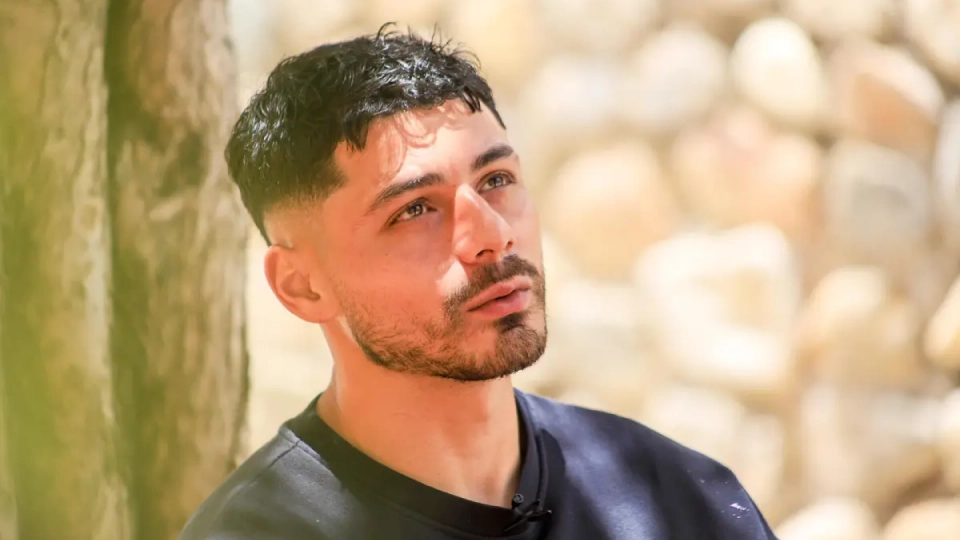
Darwin Lom is the leading scorer for Club The Strongest in the 2026 FBF División Profesional campaign, sharing the division’s top – three scoring chart with three goals from the opening matchdays. His early – season productivity has established him as the focal point of The Strongest’s forward line and a player to watch as the campaign develops through the coming months.
Martín Cauteruccio (Liga 2026 Overall Leader – Bolívar, 5 Goals)
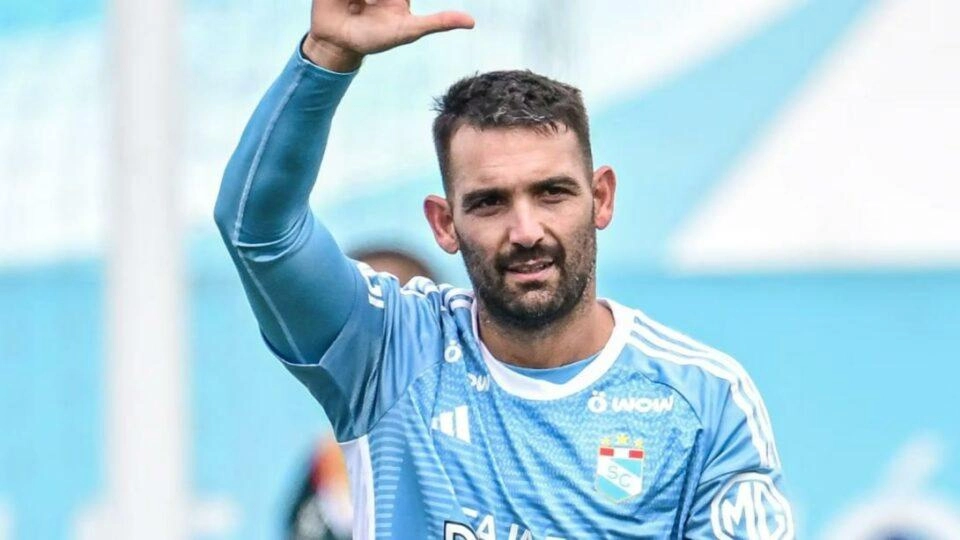
As context for the current season’s scoring landscape, Argentine striker Martín Cauteruccio of Bolívar leads the overall División Profesional 2026 scoring charts with five goals – highlighting the intensity of competition at the top of the Bolivian league’s attacking rankings and the benchmark against which The Strongest’s attackers are measuring themselves.
Óscar Villalba – 25 Goals (2025 Season Champion)
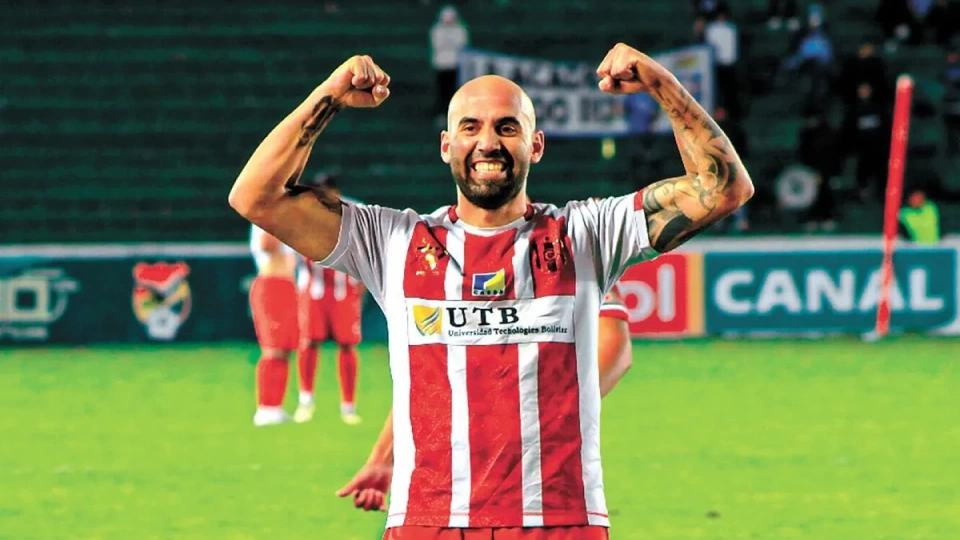
Óscar Villalba was the top scorer of the entire 2025 FBF División Profesional season with 25 goals – a remarkable tally that made him the most prolific striker in Bolivian football during that campaign. His output across the 2025 season provides historical context for the standard of attacking play that The Strongest’s squad has been built around in recent years.
For the complete and continuously updated breakdown of individual goal tallies, assist data, and player performance statistics for the full 2026 FBF División Profesional campaign, visit the dedicated Statistics section of this portal.
Frequently Asked Questions
When was Club The Strongest founded?
Club The Strongest was founded on 8 April 1908 by a group of twelve students in La Paz, Bolivia. The club’s first president was José León López Villamil, and the institution was originally called “Strong Football Club” before adopting its current name. It is the oldest continuously active football club in Bolivia.
What stadium does Club The Strongest play at?
Club The Strongest plays the majority of its home matches at the Estadio Hernando Siles in the Miraflores district of La Paz, Bolivia. The national stadium has a capacity of 42,000 spectators and sits at an altitude of approximately 3,637 metres above sea level. The club also owns the Estadio Rafael Mendoza in the Achumani complex, which has a capacity of 15,000.
What league does Club The Strongest compete in?
Club The Strongest competes in the FBF División Profesional – officially the División Profesional del Fútbol Boliviano – which is the top division of professional football in Bolivia. The club has competed in the Bolivian top flight without interruption for over a century, making them the only club in the country to have maintained continuous top – flight membership for that duration.
Who is Club The Strongest’s current head coach?
The current head coach of Club The Strongest is Joaquín Monasterio, a Bolivian trainer born on 13 June 1984, who was officially appointed and presented on 11 July 2025. Monasterio holds a CONMEBOL Pro licence and succeeded Argentine coach Carlos Bustos following a challenging first half of the 2025 season.
What are Club The Strongest’s major achievements?
Club The Strongest has won 16 FBF División Profesional titles, most recently in 2023, making them Bolivia’s second most successful club in the professional era behind rivals Bolívar. The club achieved an unprecedented seven consecutive national championships in the 1960s, won the inaugural professional league title in 1977, and became the first – ever Bicampeón under the modern format in 2003. On the continental stage, The Strongest achieved Bolivia’s first – ever away club victory in 1965 when they defeated Ecuador’s Deportivo Quito in the Copa Libertadores, and in 2005 recorded their deepest Copa Sudamericana run. The club is also uniquely historic in global football: the Batalla de Cañada Strongest – a decisive engagement in Bolivia’s Chaco War of 1932 – 1935, fought largely by club members – is the only military battle in history officially named after a football club.